Why the AI Super Intelligence Revolution Doesn't Translate Directly to Biotech
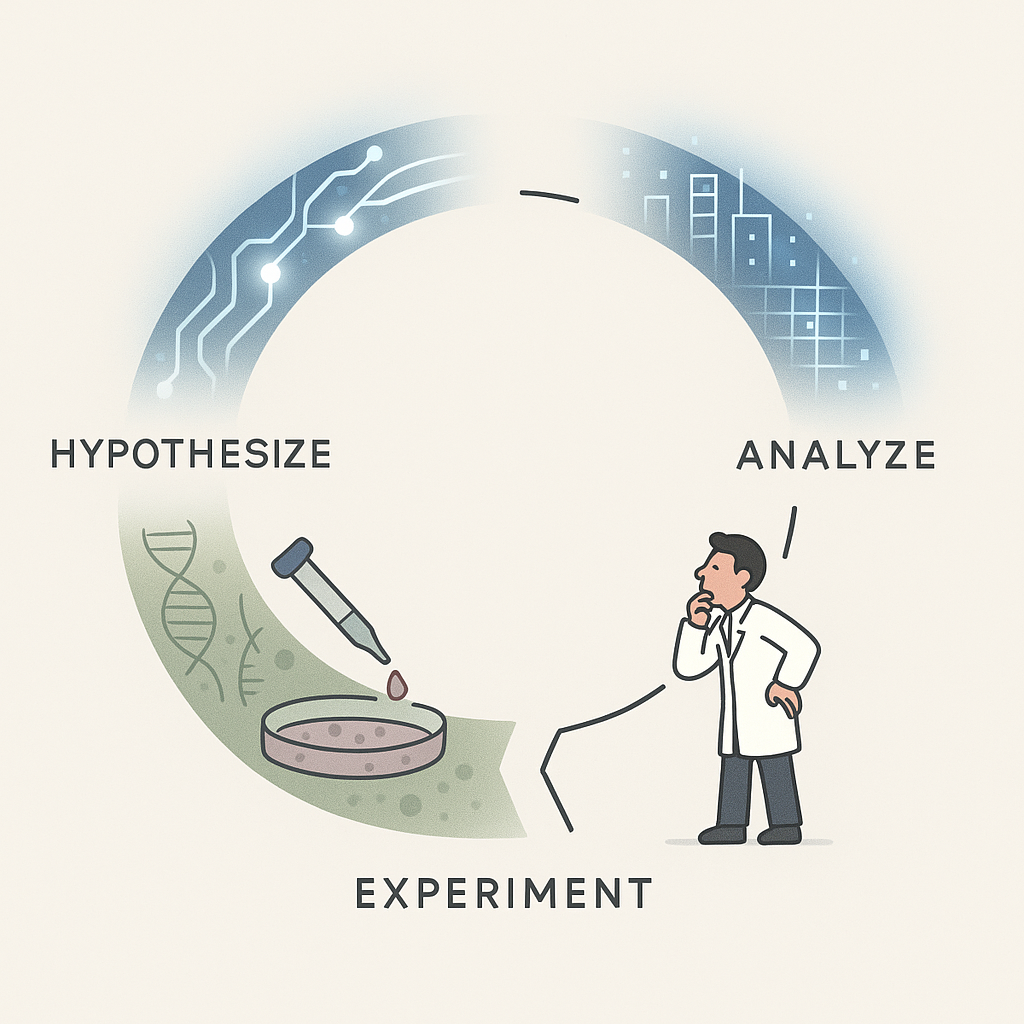 The current hype cycle might make you believe otherwise, but accelerated learning has fundamental limits when applied to Biology.
Many new companies in all industries today are built around artificial intelligence (AI)1. But the mere presence of faster, more capable models does not mean the same kind of “takeoff” applies in biology. Several structural and domain-specific constraints intervene.
1. Data scarcity, heterogeneity, and measurement noise
In domains like text or images, we enjoy abundant, well-labeled, high-volume datasets. In biology, many of the problems are data-starved: experiments are expensive, slow, and low throughput. Even for bioprocessing, datasets are often small, missing, or biased. Recent reviews detail how machine learning in upstream bioprocessing must cope with small-data regimes and complex noise patterns.2
Furthermore, biological data is enormously heterogeneous: gene expression data, proteomic assays, imaging, metabolic flux, clinical endpoints, etc. Mapping across these modalities reliably is a grand challenge. Models trained on one cell line or assay may fail to generalize even within “nearby” biological contexts.3
Add to that measurement noise, batch effects, sample biases, and reproducibility issues, and many predictive “improvements” are fragile or non-robust when pushed outside training conditions.
2. The gap between correlation and causation
AI systems (at least in their current form) are superb at pattern recognition and interpolation, but biological interventions require causal understanding. Predicting that gene expression A correlates with outcome X is one thing; reliably designing an intervention to change A so that X shifts is quite another. Multiscale biological systems are highly nonlinear, context dependent, and have feedback loops. Many ML methods struggle with mechanistic reasoning, especially across scales.4
Thus “scale up model size / compute / data” is less directly useful when the central task is experimental intervention and redesign, not merely classification or prediction.
3. The experimental bottleneck & infrastructure lag
Even if an AI model proposes a promising novel protein, circuit, or gene target, one still needs to build and test it in the lab. Current wet-lab workflows — pipetting, cell culture, cloning, phenotyping — are still often manual, slow, and inconsistent. AI cannot run wet experiments; it only proposes hypotheses. Without orders-of-magnitude improvements in lab automation, throughput, and standardization, the rate of hypothesis testing remains a bottleneck.5
Moreover, lab data formats are siloed, poor in metadata, and lack common standards. Integrating across institutions is hard. AI engineers often complain that the “last mile” is messy spreadsheets, ad hoc protocols, and data locked in proprietary formats.6
4. Regulatory, safety, and ethical constraints
Unlike AI in consumer software, biotech startups must navigate a gauntlet of safety and regulatory oversight (e.g. for therapeutics, environmental release, gene editing). Proposals must often go through animal studies, clinical trials, biosafety reviews, and regulatory scrutiny. Even a perfect computational proposal must survive all these stages. The time delays and failure rates are orders of magnitude larger than in software.7
In some domains (e.g. pathogen engineering), experts explicitly warn that AI’s near-term role is “assistive,” not autonomous, because of biological trade-offs, constraints on transmissibility, stability, and generalization.8
5. Diminishing returns and model complexity walls
In classic AI scaling (e.g. large language models), each doubling of compute/data often brings consistent incremental performance gains. But in biotech, the returns flatten earlier: incremental gains require exponentially more data, more careful validation, or deeper domain insight. Also, “complexity walls” arise: models fail when dependencies span many interacting subsystems (metabolism, signaling networks, epigenetics, environment), which is much more common in biology than in typical NLP tasks.9
Put differently: while language offers a quasi-modular structure (words, grammar, semantics) that scales fairly cleanly, biology is deeply intertwined, context-sensitive, and full of exceptions.
What AI can meaningfully contribute in biotech — and where the frontier lies
That said, dismissing AI’s role would be wrong. The future is likely hybrid and domain-aware, not entirely absent.
- Hypothesis generation & augmentation: AI can suggest candidate genes, mutations, or small molecules worthy of wet testing.
- Assay optimization and experimental design: AI can help pick which experiments to run next (active learning), optimize parameter sweeps, and reduce wasted cycles.
- In silico screening & filtering: Early pruning of grossly unpromising designs (e.g. toxicity alerts, folding infeasibility) can save lab cycles.
- Quality control, anomaly detection, and process control: In biomanufacturing, AI can flag batch failures or drift, optimize yields, and monitor robustness.10
- Data harmonization & integration: Building bio-native knowledge graphs, cleaning and aligning disparate data sources, enabling better downstream modeling.
- Domain-tailored architectures: Instead of generic LLMs, models built for biology (e.g. protein transformers, graph neural nets on molecular graphs) will matter more than sheer scale.11
In short: AI’s power in biotech is less about “superintelligence” scaling and more about searching more intelligently in constrained, high-risk design spaces.
Conclusion: managing expectations, investing in foundations
The AI hype cycle tends to extrapolate “fast learning ⇒ fast invention” without accounting for domain friction. In biotech, the friction is real: experimental cost, regulatory overhead, causal reasoning, data scarcity, and infrastructure gaps. These combine to flatten the path toward radical AI takeover.
A better stance for founders, investors, and scientists is patient realism: invest in experimental automation, metadata standards, shared data infrastructure, tighter human-AI loops, and domain-specific architectures. Over time, the leverage of AI will grow — but it is unlikely to deliver an overnight superintelligence revolution in biology in the same way it might in code or text.
Footnotes
-
Machine Learning in Upstream Bioprocessing: Challenges in Small-Data Regimes, arXiv (2025). https://arxiv.org/abs/2506.12322 ↩
-
Teschendorff AE. Avoiding Common Pitfalls in Machine Learning Omics Data, Genome Biology (2020). https://pmc.ncbi.nlm.nih.gov/articles/PMC7233077/ ↩
-
Schölkopf et al. Causality for Machine Learning, arXiv:1910.01258. https://arxiv.org/abs/1910.01258 ↩
-
Biology’s Bottleneck: AI Can’t Deliver Without Better Lab Infrastructure, Genetic Engineering & Biotechnology News (2024). https://www.genengnews.com/topics/artificial-intelligence/biologys-bottleneck-ai-cant-deliver-without-better-lab-infrastructure/ ↩
-
Ibid. ↩
-
From Lab to Market: Challenges in Scaling Biotech Innovations, MRL Consulting (2024). https://www.mrlcg.com/resources/blog/from-lab-to-market-challenges-in-scaling-biotech-innovations/ ↩
-
AI and the Biological Threat Landscape, RAND Corporation (2024). https://www.rand.org/pubs/research_reports/RRA4087-1.html ↩
-
The Limits of Generic LLMs: Why Biotech Needs Purpose-Built Tools, Luma Group (2025). https://lumagroup.com/the-limits-of-generic-llms-why-biotech-needs-purpose-built-tools/ ↩
-
AI in Biomanufacturing: Process Optimization and Yield Prediction, arXiv:2310.09991 (2023). https://arxiv.org/abs/2310.09991 ↩
-
EvolutionaryScale Lands $142M to Advance AI for Biology, Reuters (2024). https://www.reuters.com/technology/evolutionaryscale-lands-142-mln-advance-ai-biology-2024-06-25/ ↩